

Solarpunk by Radical Indigenism
On Decolonizing a Genre for the Design of Plausible Ecological Futures

Over the past few days, I have been looking more carefully into solarpunk, not only as a genre label, but as a positioning question.
I have recently decided to associate my novel series, SYNTOPIA, much more directly with solarpunk. It may seem obvious if you have read the book, since it’s all about ecological transition, community autonomy entering rebellion (the “punk” factor in solarpunk), low-tech systems with salvaged materials, food sovereignty, and renewable energy. But I hesitated…
The keyword “solarpunk” as a genre is extremely useful because it opens a recognizable door and a clear shelf for the book. But every label is also a frame, and every frame risks narrowing the reading of a work before the work has had a chance to speak for itself.
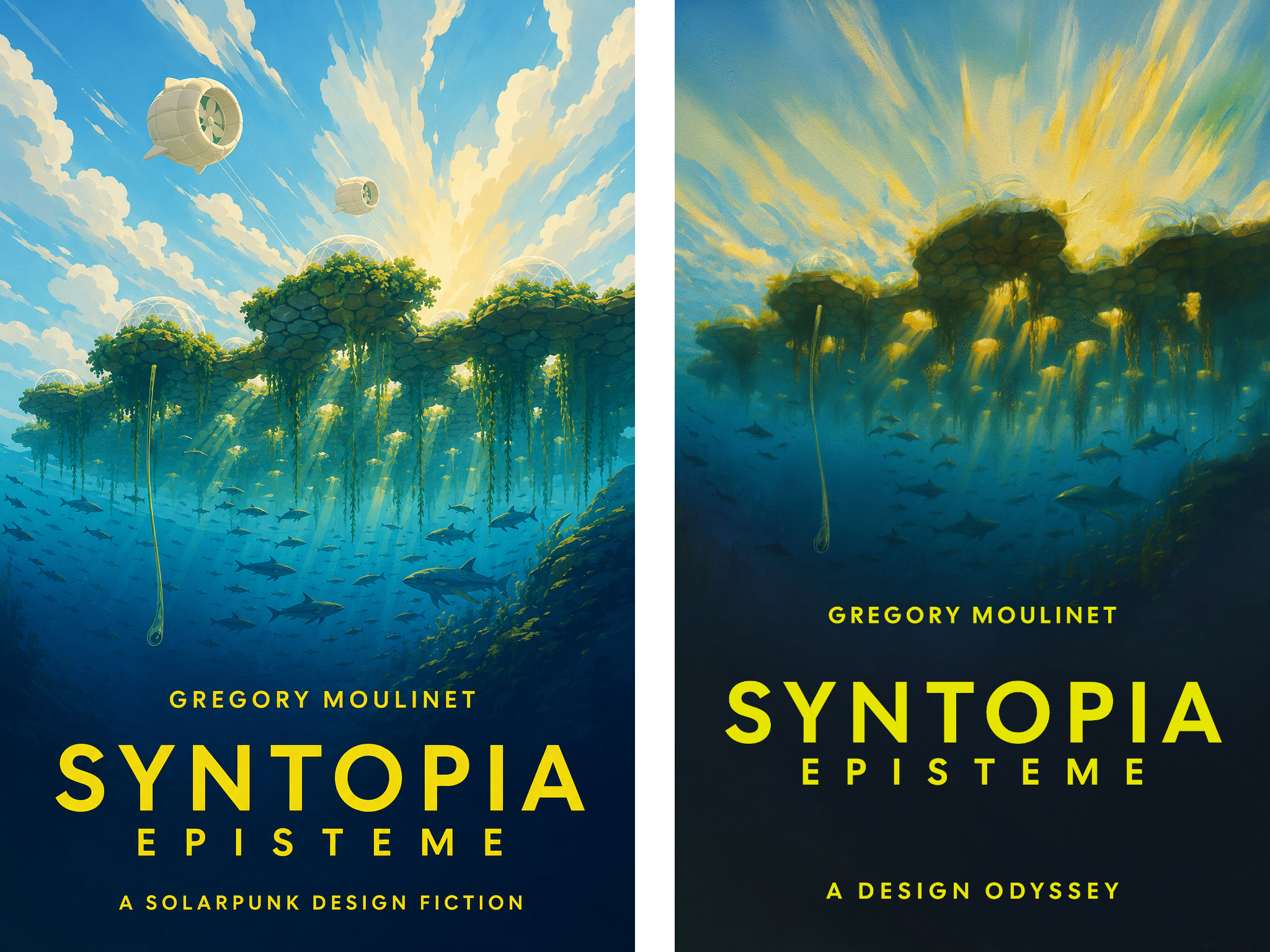
My hesitation came from the dominant aesthetic often associated with solarpunk: lush cities, beautiful communal spaces, solar panels, gardens, light, optimism, alternating between Studio Ghibli postcards and greenwashed cyberpunk. I understand the appeal, and more than ever we need recognizable images that oppose the tired grammar of dystopia. We need futures that do not begin or end with collapse.
But SYNTOPIA is not dreamy… No magic, no fantasy, no cheap spiritualism, and very little romance. Its worldbuilding is meant to remain hyper-realistic and plausible, even when the story becomes epic. Its technologies may be speculative, but they are designed to be technically, materially, and geopolitically possible. Its floating islands are not symbols of hope. They are built from ocean plastic, salvage, existing low-tech solutions, indigenous maritime knowledge, diverse food systems, passive water systems, real energy constraints, tackling realistic governance tensions, very plausible corporate and military pressure, and the intelligence of a community that cannot afford theorizing its survival.
So the question for me was not: Does SYNTOPIA fit with the optimism usually attached to solarpunk?
But: Can solarpunk be taken as a rigorous and serious enough genre to hold SYNTOPIA?
A short Genealogy of Solarpunk
The word solarpunk appeared online in 2008 in a blog post titled “From Steampunk to Solarpunk,” published by Republic of the Bees. The author (his/her full identity remains unclear) proposed the term by contrasting it with steampunk. Where steampunk imagined alternative worlds shaped by Victorian steam technologies, solarpunk would revive or reinvent technologies suited to a post-fossil-fuel world: solar power, wind power, sailing, muscle power, water power, and other practical alternatives. What is striking in that early formulation is the insistence that solarpunk technologies “need not remain imaginary.” Solarpunk began, at least in this formulation, as speculative fiction with one foot already in engineering, economics, and political transition.
In 2014, Adam Flynn’s “Solarpunk: Notes toward a manifesto,” published through Arizona State University’s Project Hieroglyph, helped the term cohere more clearly as a cultural movement in confrontation with the popular dystopian cyberpunk genre. Flynn described solarpunk as being about “ingenuity, generativity, independence, and community,” and insisted that the future must involve “repurposing and creating new things from what we already have.”
Since then, solarpunk has developed as a porous movement across fiction, visual art, architecture, games, fashion, activism, and design culture. Solarpunk Magazine defines it as a prefigurative, utopian artistic movement imagining futures where humanity has addressed major challenges such as climate change and created more sustainable and balanced societies. It explicitly includes values such as decolonization, anti-racism, anti-authoritarianism, anti-corporatism, animal rights, and harmony between nature and technology.
Does SYNTOPIA pass the Solarpunk test?
If solarpunk is mostly a visual style, then SYNTOPIA deviates from it. As a designer, I am trying to define it, but beyond the cover I illustrated myself, I have right now little to show to demonstrate this difference visually. Its aesthetic is mostly maritime rather than urban. Its world is not a garden city but a floating archipelago with a food forest in its center. Its protagonist is not a citizen of a comfortable post-carbon metropolis, but a young Bajau Laut woman, a southeast asian sea nomad, whose life begins in statelessness. Its central community is an Indigenous maritime people pushed to the edge of nation-states, military zones, fishing conflicts, extraction interests, and ecological collapse.
But if solarpunk is judged ethically, politically, and philosophically, then SYNTOPIA fits almost too precisely.
Does the story reject dystopian resignation?
Yes.
Does it imagine a regenerative ecological future?
Yes.
Does it center on renewable energy, circularity, repair, and autonomy?
Yes, Yes, Yes and Yes.
Does it treat technology as useful only when subordinated to life?
Yes!
Does it challenge extractive capitalism, imperial geopolitics, and corporate control over common resources?
Yep.
Does it imagine community resilience rather than individual escape?
Yes.
Does it understand design as a way to reorganize relationships rather than merely produce objects?
Dah!
Does it treat the future as something built through conflict, negotiation, maintenance, and care?
Yes.
I will return to the low-tech/lo-TEK aspect later. For now, I want to focus on the Indigenous question.
Is Solarpunk Doomed?
A video by Myriam Ferreira recently helped me clarify the issue.
Her argument is encapsulated in this sentence: solarpunk is doomed without Indigenous leadership.
Her point, as I understand it, is that if solarpunk wants technologies to integrate harmoniously with ecosystems instead of dominating them, then those technologies require specific, thorough, place-based knowledge of how those ecosystems actually work. Modern technological systems, especially when designed at industrial scale and from afar, lack consistent understanding and knowledge. They see the planet through models, abstractions, datasets, markets, simulations, and standards.
Ferreira then introduces the concept of Traditional Ecological Knowledge, or TEK for short.
A commonly cited definition describes TEK as a cumulative body of knowledge, practice, and belief, evolving through adaptive processes and handed down across generations, concerning the relationships between living beings, including humans, and their environment.
In our modern technological systems, our ‘TECHNOSPHERE’, biodiversity knowledge at large scales remains deeply incomplete. Ferreira cites Joaquín Hortal and colleagues’ paper describing the “seven shortfalls” that beset large-scale knowledge of biodiversity. Namely: gaps in knowledge about taxonomy, distributions, abundance, evolutionary relationships, traits, abiotic tolerances, and biotic interactions.
Ferreira concludes that a solarpunk project cannot simply assume that centralized technological intelligence knows enough to design ecological harmony from above. We need science. We need data. We need engineering. But we also need the people who know specific places through long duration, practical responsibility, embodied observation, seasonal memory, cultural transmission, and daily consequence.
This is epistemology 101.
The Evidences
Indigenous peoples represent around 6% of the global population but safeguard roughly 80% of the planet’s remaining biodiversity. That’s about 476.6 million Indigenous Peoples worldwide. Indigenous Peoples manage or hold tenure rights to roughly 1/5 of the world’s surface area, including a significant portion of biodiversity and over half of remaining intact forests.
Indigenous Peoples play an outsized role in biodiversity conservation, intact forests, restoration, and stewardship. But they are ignored or intentionally designed out of the conversation, as Ferreira puts it.
Indigenous Peoples also face a disproportionate share of violence for doing so. Global Witness reported at least 146 land and environmental defenders were killed or disappeared in 2024.
A 2021 Nature Sustainability study, published in 2022, examined deforestation and degradation from 2010 to 2018 across 3.4 million square kilometers of Indigenous Lands, 2 million square kilometers of protected areas, and 1.7 million square kilometers of overlapping protected Indigenous areas across tropical moist forests. The study found that deforestation and degradation in Africa were significantly reduced in Indigenous Lands compared to nationally protected areas, much more effectively than government-protected areas.
Similarly, the World Resources Institute reported that forests managed by Indigenous peoples in the Amazon were strong net carbon sinks from 2001 to 2021, collectively removing a net 340 million tonnes of CO2 from the atmosphere each year, roughly equivalent to the United Kingdom’s annual fossil-fuel emissions. Forests outside Amazon Indigenous lands, by contrast, were collectively a net carbon source due to forest loss and fires.
These studies cited by Ferreira are among the strongest empirical foundations we have for imagining Indigenous-led ecological futures that actually work.
Consequences of Ignoring TEK
Ferreira points toward what happens when Indigenous knowledge and warnings are ignored.
The case of the Wabigoon-English River system and Grassy Narrows First Nation in Canada is one of the clearest examples. In 1962, a chloralkali plant began discharging mercury into the river system, contaminating waters central to Grassy Narrows’ livelihood, diet, and traditions. A 2025 retrospective study in Environmental Health examined childhood mercury exposure and survival to July 1, 2024. Among the children whose hair-mercury measurements were available, 44.2 percent had hair mercury at or above 4 micrograms per gram at least once, and by July 2024, 30.6 percent of the cohort had died, with a median age of 39. Childhood mercury exposure was associated with nearly double the hazard of death.
When ecosystems are treated as externalities and indigenous knowledge is ignored, toxins do not remain external. They move through forests, watersheds, sediments, fish, mothers, children, nervous systems, and generations.
This is why a plausible solarpunk future must understand the biochemical, hydrological, cultural, and political consequences of intervention. It must understand that a river is never “just” water. It is food, flow, memory, ceremony, metabolism, law, kinship, and future for the physical world.
Indigenous as A People
I really appreciate Ferreira’s argument and framing and fully agree that solarpunk is in danger of becoming an irrelevant deco-greenwashed-meme if it does not fully integrate Indigenous knowledge, Indigenous leadership, and TEK.
But I have a problem with presenting Indigenous peopleS as one single group with a single universal mindset.
There is no singular “Indigenous view.” Indigenous peoples are radically diverse. They are place-based peoples whose knowledge emerges from specific relations with specific lands, waters, species, climates, histories, traumas, ceremonies, languages, internal political and religious struggles, and their more or less recent or contemporary experience with religious missions, colonialism, neo-colonialism, and global industrialisation.
All have been affected in different ways in the last five centuries by extraction, forced assimilation, slavery, displacement, genocide, land theft, market capture, state violence, pogroms, conservation displacement, and cultural erasure.
So we cannot talk about Indigenous leadership without talking about decolonization.
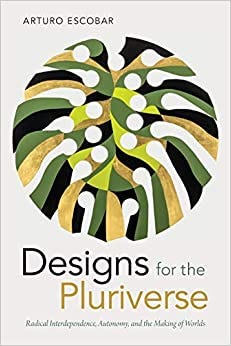
In, Designs for the Pluriverse, Arturo Escobar argues for autonomous, collaborative, place-based design practices attuned to justice and the Earth, while mapping autonomous design to the decolonial struggles of Indigenous and Afro-descended communities in Latin America. His work is about redesigning the practice of design itself away from universal modernity and toward many embodied worlds—the Pluriverse.
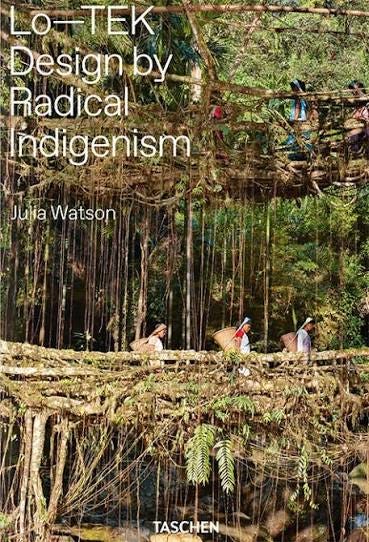
In Lo—TEK: Design by Radical Indigenism, Julia Watson presents nature-based technologies rooted in Indigenous traditional knowledge as sustainable solutions and proposes an alternative story of technological evolution. In her last book Lo—TEK water, we are introduced to Indigenous Regenerative Ecosystems Designs ( (IREDs) by Dr. Lyla June Johnston a an Indigenous musician, scholar, and community organizer of Diné (Navajo), Tsétsêhéstâhese (Cheyenne) linage.
Both Escobar and Watson help move the conversation beyond “Indigenous acknowledgment” toward something much more practical: autonomy, knowledge sovereignty, technological humility, and the possibility of many situated futures.
TEK is not enough
There is another point that matters deeply to me, and it is central to the novel series SYNTOPIA.
Indigenous knowledge is essential. But knowledge alone is not enough.
Knowledge without ethos can still become extraction. A corporation can learn from local ecological practices and turn them into patents. A state can map Indigenous land and use the data for surveillance. A designer can study the vernacular and convert it into luxury architecture or fashion. A university can extract TEK as “data” while ignoring sovereignty, consent, and reciprocity.
What matters is not what is known, but the worldview that governs how this knowledge is used.
There are a few commonalities across many Indigenous traditions. One of them is the biocentric outlook: an understanding that human beings are not the center, owner, or master of the living world. Humans are participants in a larger web of relations. Animals, plants, rivers, mountains, winds, ancestors, and future generations are not separated at all. They are interdependent and viewed as such.
In this respect, Robin Wall Kimmerer’s Braiding Sweetgrass brings together Indigenous wisdom, scientific knowledge, and the teachings of plants. As a botanist and member of the Citizen Potawatomi Nation, Kimmerer writes from both scientific training and Indigenous relational knowledge, showing how conventional science can be practiced through the biocentric ethos of reciprocity, gratitude, and responsibility.
A plausible solarpunk future would not just need Indigenous knowledge for the interesting and exotic content it provides; It requires the ethos that has driven this constituted knowledge, along with the design and the Lo-TEK, that has emerged from it.
Without that ethos, solarpunk remains vulnerable to greenwashing and cheap spirituality.
The Reddit Reaction
Upon discussing Ferreira’s video in the historical Tumblr solarpunk group , someone pointed me toward a Reddit debate where many commenters accused her argument of racism or racial essentialism.
The most popular responses argued, in substance, that Indigenous people can be excellent environmental stewards or hypocrites; that settlers, colonists, and immigrants can also destroy or restore landscapes; and that we should follow good ideas wherever they come from rather than elevate any group by ancestry.
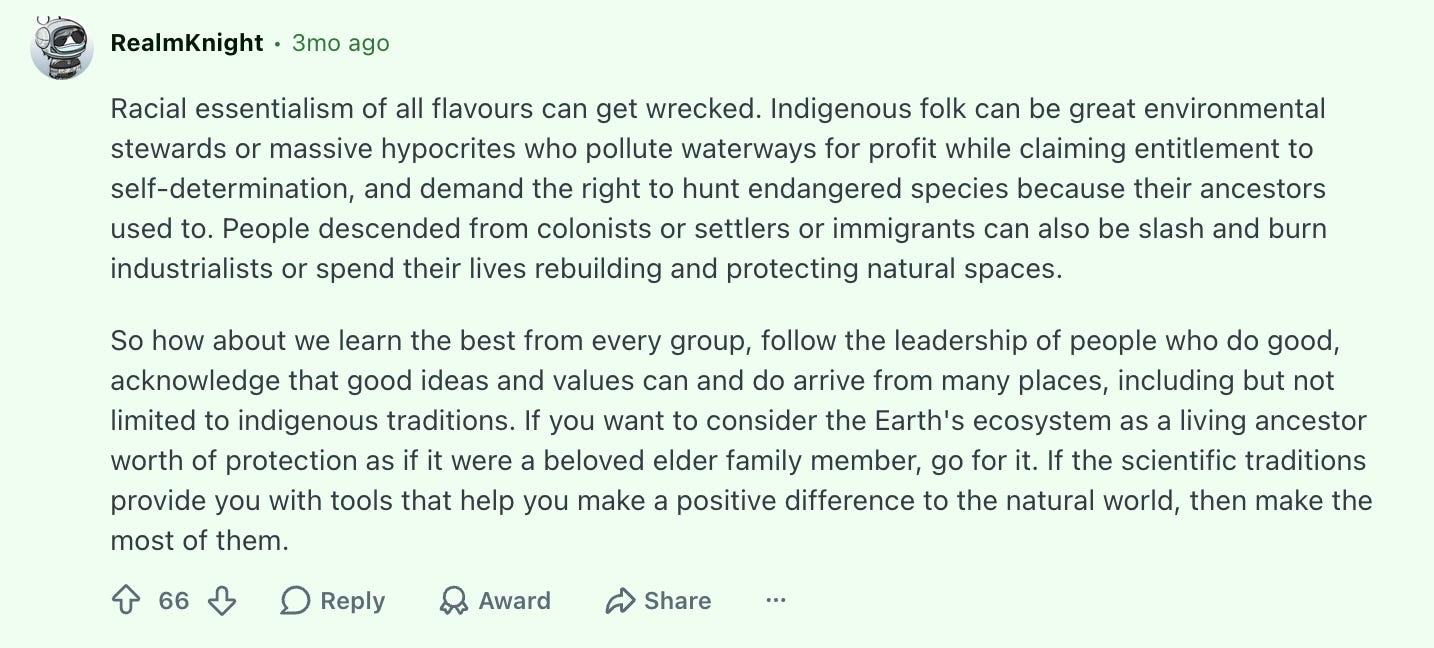
While there is a reasonable warning inside that comment—namely, that virtue does not belong to blood—people born and raised within an Indigenous society are more likely to know, viscerally and practically, the features, limits, and history of the habitat on which they and their community have depended for thousands of years than an anthropologist who has read all the academic papers he could find before being parachuted into that same place.
Indigenous peoples are, in fact, concerned agents, not merely the moral subjects of scientific study.
But the comment misses the central frame of Ferreira’s video. Indigenous leadership is not a claim of superior ecological wisdom encoded in DNA. It is a claim grounded in history, place, continuity, and the generational accumulation of situated knowledge.
If a people has lived in deep relation with a territory for centuries or millennia; if their food systems, stories, technologies, ceremonies, and survival strategies were shaped by that place before they were violently dispossessed by industrial systems that then proceeded to extract from and destroy that same ecosystem; and if we now look at our current climate trajectory, rushing toward 2°C of warming within our lifetime, then what does that say about the authority and competence of “our knowledge” compared with Indigenous knowledge?
“Let us learn the best from every group” may sound reasonable. But it conveniently erases the deeper question: who has been systematically prevented from leading? Who has been dispossessed? Whose knowledge has been stolen? Whose land has been mined? Whose rivers have been poisoned? Whose deaths have been counted as the acceptable cost of progress?
To make Solarpunk relevant again, we must begin by acknowledging that the world we inhabit has been largely shaped by colonialism, extractive capitalism, industrial agriculture, fossil fuels, militarized borders, and anthropocentric design. In such a world, “following the best ideas” usually means following the institutions that already control capital, legitimacy, infrastructure, publishing platforms, patents, universities, and state power.
Indigenous leadership is not about identity as such—racial, religious, or otherwise.
Indigenous leadership is about repairing the conditions under which evidence, knowledge, land, and life were separated in the first place.
One buried Reddit comment, apparently from an Indigenous person, captured the emotional truth of the debate:

Apparently, solarpunk aficionados may want Indigenous knowledge, but not the discomfort of Indigenous critique.
The Pluriversal Solarpunk Genre
When my protagonist begins co-designing with her community, she does not arrive as the heroic designer who knows better than everyone else. She gathers knowledge. She uses design thinking tools such as the Thinking Hats to structure debate. She listens to priorities that emerge from the community’s lived relationship with the sea.
At one point, a U.S. engineer insists on technical solutions that require energy and infrastructure to capture and store this energy. His logic is not wrong. Technically, his solutions may be elegant. But the Bajau community has a different priority: food sovereignty.
That priority changes the entire design approach. Food comes before technological facilitations. Capacity for maintenance comes before leverage and optimization. The engineer eventually admits that his priority will have to wait. The design outcome follows Indigenous priorities and existing knowledge because those priorities emerge from their actual lived conditions.
In SYNTOPIA, imported technologies are mostly low-tech. They are evaluated by whether they serve life, strengthen autonomy, remain repairable, reduce dependency, respect ecological and physical boundaries, and fit the TEK of those who must live with its consequences.
I would describe SYNTOPIA’s genre as Pluriversal Solarpunk: not one global aesthetic of green futures, but a family of place-based ecological futures shaped by different peoples, territories, climates, histories, materials, and ways of knowing. A Bajau solarpunk will not look like a Sámi solarpunk. A Caribbean solarpunk will not look like an Amazonian solarpunk. A Sahelian solarpunk will not look like a Mongolian grassland solarpunk. A coastal solarpunk will not look like an oceanic solarpunk, even if both must negotiate life on water.
Pluriversal solarpunk asks place-based questions: whose knowledge, whose land, whose waters, whose risks, and whose priorities make that future possible? It shifts the genre away from universal green imagery and toward situated design, decolonial politics, ecological cognition, and community sovereignty.
It makes solarpunk become politically mature when it stops imagining one desirable future for everyone and begins to imagine many worlds negotiating how to remain alive together.
Solarpunk grounded in Lo-TEK, biospheric science, low-tech engineering, community autonomy, and a sincere respect for life in all its forms may begin to feel plausible. Plausible Solarpunk futures.